-->
Showing posts with label Innovation. Show all posts

November 4, 2010

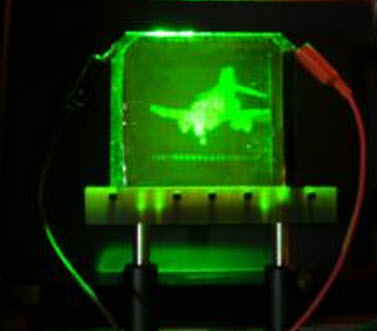
Three-dimensional moving holograms breakthrough

A team led by University of Arizona (UA) optical sciences professor Nasser Peyghambarian has developed a new type of “holographic telepresence” that allows remote projection of a three-dimensional, moving image without the need for special eyewear such as 3D glasses or other auxiliary devices.

The technology is likely to take applications ranging from telemedicine, advertising, updatable 3D maps and entertainment to a new level.

The journal Nature chose the technology to feature on the cover of its Nov. 4 issue.

“Holographic telepresence means we can record a three-dimensional image in one location and show it in another location, in real-time, anywhere in the world,” said Peyghambarian, who led the research effort.
“Holographic stereography has been capable of providing excellent resolution and depth reproduction on large-scale 3D static images,” the authors wrote, “but has been missing dynamic updating capability until now.”
“At the heart of the system is a screen made from a novel photorefractive material, capable of refreshing holograms every two seconds, making it the first to achieve a speed that can be described as quasi-real-time,” said Pierre-Alexandre Blanche, an assistant research professor in the UA College of Optical Sciences and lead author of the Nature paper.

The prototype device uses a 10-inch screen, but Peyghambarian’s group is already successfully testing a much larger version with a 17-inch screen. The image is recorded using an array of regular cameras, each of which views the object from a different perspective. The more cameras that are used, the more refined the final holographic presentation will appear.

That information is then encoded onto a fast-pulsed laser beam, which interferes with another beam that serves as a reference. The resulting interference pattern is written into the photorefractive polymer, creating and storing the image. Each laser pulse records an individual “hogel” in the polymer. A hogel (holographic pixel) is the three-dimensional version of a pixel, the basic units that make up the picture.

The hologram fades away by natural dark decay after a couple of minutes or seconds depending on experimental parameters. Or it can be erased by recording a new 3D image, creating a new diffraction structure and deleting the old pattern.

Peyghambarian explained: “Let’s say I want to give a presentation in New York. All I need is an array of cameras here in my Tucson office and a fast Internet connection. At the other end, in New York, there would be the 3D display using our laser system. Everything is fully automated and controlled by computer. As the image signals are transmitted, the lasers inscribe them into the screen and render them into a three-dimensional projection of me speaking.”

The overall recording setup is insensitive to vibration because of the short pulse duration and therefore suited for industrial environment applications without any special need for vibration, noise or temperature control.

One of the system’s major hallmarks never achieved before is what Peyghambarian’s group calls full parallax: “As you move your head left and right or up and down, you see different perspectives. This makes for a very life-like image. Humans are used to seeing things in 3D.”

The work is a result of a collaboration between the UA and Nitto Denko Technical, or NDT, a company in Oceanside, Calif. NDT provided the polymer sample and media preparation. “We have made major advances in photorefractive polymer film fabrication that allow for the very interesting 3D images obtained in our Nature article,” said Michiharu Yamamoto, vice president at NDT and co-author of the paper.

Potential applications of holographic telepresence include advertising, updatable 3D maps and entertainment. Telemedicine is another potential application: “Surgeons at different locations around the world can observe in 3D, in real time, and participate in the surgical procedure,” the authors wrote.

The system is a major advance over computer-generated holograms, which place high demands on computing power and take too long to be generated to be practical for any real-time applications.

Currently, the telepresence system can present in one color only, but Peyghambarian and his team have already demonstrated multi-color 3D display devices capable of writing images at a faster refresh rate, approaching the smooth transitions of images on a TV screen. These devices could be incorporated into a telepresence setup in the near future.

Source: http://www.kurzweilai.net


September 23, 2010

Forever young: Secret of eternal life revealed by Russian science?

August 26, 2010

Diamonds Are a Supercomputer’s Best Friend


Diamond sheets filled with holes could be the key to the next generation of supercomputers.

Scientists in California have used commercially available technology to pattern large sheets of diamonds with tiny, nitrogen-filled holes. The nitrogen-vacancy diamonds, as the sheets are called by scientists, could store millions of times more information than current silicon-based systems and process that information dozens of times faster.

Exactly how diamond-based computing would be used has yet to be determined, but applications could range from designing more efficient silicon-based computers to drug development and cryptography.

Nitrogen has been in diamonds for as long as their have been diamonds; it’s why some diamonds have a yellow hue. For years scientists have used these natural, nitrogen-infused diamonds to study various aspects of quantum mechanics.

“We’ve used well-known techniques to create atomic-size defects in otherwise perfect diamonds,” said David Awschalom, a scientist at the University of California, Santa Barbara and co-author of a new article in the journal ACS Nano Letters.

A supercomputer based on quantum mechanics requires more precision than nature can provide, so scientists have searched for a way to artificially implant arrays of precisely patterned nitrogen holes inside sheets of diamond.

Scientists from the University of California, Santa Barbara, along with colleagues from the Lawrence Berkeley National Laboratory, created such an array by using an ion beam to first knock out two carbon atoms, and then replace them with one nitrogen atom. In one second, the scientists could inject about 4,000 glowing nitrogen atoms. In about one minute, the scientists had patterned several inches of flat diamond.

The scientists didn’t use any overly complicated techniques to accomplish this. “You can buy it online, send it to another company for the patterning, and then explore it yourself,” said Awschalom, whose students did exactly that to demonstrate the ease of the technology.

The key to a diamond-based quantum mechanical computer is an extra electron in the hole. In a traditional computer, information is encoded as either a “0″ or a “1.” In a diamond-based quantum computer, information could be stored in the spin of that electron. This means information could be stored as not only a “0″ or “1,” but also the direction the electron is spinning.

An exact number is hard to come by, but scientists say this would dramatically increase the computing power compared with existing silicon computers.

Diamonds likely wouldn’t replace the silicon used in today’s consumer computers, said Ray Beausoleil, a fellow in Information and Quantum Systems at HP. “A quantum computer won’t help you add two numbers faster,” said Beausoleil.

However, that doesn’t mean consumers won’t benefit from a diamond-based quantum computer. What it will do is help model certain extremely complex problems, says Beausoleil and David DiVincenzo, a scientist at IBM who is also familiar with the Nano Letters article.

“This points to the fruitful end of a very long search of all the things that you could put in diamond to make it electronically active,” said DiVincenzo.

Diamonds aren’t a sure bet for a quantum computer, said DiVincenzo, but they’re certainly in the running because of this research.

Source <http://tech-stories.findtechnews.net>

August 25, 2010

Solar toothbrush doesn't need toothpaste


Canadian researchers have designed a toothbrush that cleans teeth by creating a solar-powered chemical reaction in the mouth, doing away with the need for toothpaste, said physorg.com.

Dr Kunio Komiyama, a dentistry professor emeritus at the University of Saskatchewan, designed the first model of the unconventional toothbrush 15 years ago. Today, Komiyama and his colleague Dr Gerry Uswak are seeking recruits to test their newest model, the Soladey-J3X.

The toothbrush, which is manufactured by the Shiken company of Japan, will soon be tested by 120 teenagers to see how it compares to a normal toothbrush.

The Soladey-J3X has a solar panel at its base that transmits electrons to the top of the toothbrush through a lead wire. The electrons react with acid in the mouth, creating a chemical reaction that breaks down plaque and kills bacteria.

The toothbrush requires no toothpaste, and can operate with about the same amount of light as needed by a solar-powered calculator.

Last month, the researchers presented their research at the FDI Annual World Dental Conference in Dubai, where their poster won first prize out of 170 entries.

Source <www.emerites247.com>

August 15, 2010

A Car for the Modern Fred Flintstone


Fred Flintstone could only dream of such a car. The HumanCar Imagine PS, a four-seater vehicle that uses hand cranks, can take on hills at 30 miles per hour, exceed 60 mph on flat terrain and is expected to hit the market next year.

The vehicle has electric plug-in capabilities, so it can still run if only one person is operating the hand-crank in a rowing-like motion (see the video showing the action, below). When four people are all rowing, it can run on human power alone. This thing is truly a "human-electric" hybrid. The chassis is adaptable, and can work with different kinds of batteries and technology in the future without requiring an entirely new vehicle.

Getting it going looks a little bit like those wind-up toys: a few front-to-back pulls on the two-hand crank and it's ready to take off. Despite the physical requirement, the company says online that a senior citizen in decent shape could handle it and paraplegics have made suggestions on adaptability. The sleek vehicle could use a larger windshield, although there is apparently an all-weather shell available. Airbags are on the list to be included in future models. In the meantime, I'd probably wear a helmet while driving it.

Others have been hard at work on human powered cars, too. The American Society ASME runs an annual international Human Powered Vehicle Challenge, where students build aerodynamic vehicles. Next month teams will compete in Venezuela. Based on speed-endurance events that took place this year, the vehicles' top speeds are closing in on 20 miles per hour.

Higher speeds make the Imagine PS impressive. I can hardly get any miles per hour going uphill on a bike. Zooming uphill using my own energy looks so much more enjoyable. The car will cost $15,500 when it goes on sale next year, according to the HumanCar site. Potential owners can put down a refundable $50 placeholder for when the vehicles become available. So far, the company says it has 100 pre-orders and that production will begin when they reach 800.

Source <news.discovery.com>

August 12, 2010

Invisibility Cloak Made From Silk


For thousands of years people have worn shimmering silk to stand out in a crowd. Within the next few years people could wear silk to become invisible in a a crowd.

For the first time ever, scientists have created an invisibility cloak made from silk, and coated in gold.

The new metamaterial, as invisibility cloaks and their kin are technically called, only works on relatively long terahertz waves (a region of the electromagnetic spectrum between radio and infrared light), but the Boston-area scientists who developed the technology think that silk could work as an invisibility cloak at much smaller wavelengths, even in the visible range.

The research could lead to a wide range of optically unique materials for use in biomedicine or defense.

"This is an unusual angle for a metamaterial because of silk's ability to interface with the human body," something that no other metamaterial is currently capable of, said Fiorenzo Omenetto, a scientist at Tufts University who, along with colleagues at Boston University, helped develop the silk-based metamaterial and detail their new research in the journal Advanced Materials.

"On the sensing side it gives you a platform that is very adaptable."

Invisibility cloaks, along with their optically exotic cousins, perfect absorbers and perfect reflectors and others, belong to a special class of materials known as metamaterials. Unlike most materials, which derive optical properties like color from their chemical make up, metamaterials derive their properties from the physical structure.

A curly cue, or short spiral, is a common metamaterial structure. Scientists call them split ring resonators, or SSRs. Usually scrawled into metals, SSR can give ordinary materials extraordinary abilities, like absorbing or reflecting all the specific wavelengths of light, or bending a wavelength around an object.

To create their silk-based metamaterial, the Tufts and Boston University scientists, including Richard Averitt, started with a one-centimeter-square piece of silkworm silk. (In another recent paper, Omenetto's colleague and another co-author of the Advanced Material's paper, David Kaplan of Tufts, created silk-producing bacteria.) Onto that tiny piece of dielectric silk they stenciled 10,000 gold resonators.

Ordinarily when silk is exposed to terahertz waves they pass straight through it. When the new silk metamaterial was subjected to T-rays the scientists detected a resonance.

A metamaterial that works in the terahertz range is nothing new. But, unlike other metamaterials, silk is biocompatable -- the human body won't reject silk-based implants the way it does with most other materials. The scientists implanted the patterned silk into a muscle, and still detected a resonance.

The new silk research is "interesting," said Douglas Werner, a metamaterial scientist at Pennsylvania State University. "There is a lot of interest in using flexible substrates for metamaterials, and silk is a good candidate for that."

The potential applications of silk-based invisibility are huge. Omenetto and his colleagues at Tufts aren't even focused on Harry Potter or Star Trek-style invisibility materials, although he says that is one potential application.

Their main focus is in biomedical applications. One of the first biomedical uses could be as an implantable glucose sensor for diabetics. As the level of glucose changes inside the body, it changes the silk. Then as the silk changes, do does the metamaterial printed on the silk. That change would then be relayed to the person's cell phone; no needle prick necessary.

Silk-based invisibility would also allow doctors and radiologists to cloak various organs or tissues and see through them, said Omenetto, getting a better image of the organs or tissues usually hidden behind.

Source <news.discovery.com>

August 9, 2010

Gasoline from Thin Air?

An enzyme found in the roots of soybeans could be the key to cars that run on air.

Vanadium nitrogenase, an enzyme that normally produces ammonia from nitrogen gas, can also convert carbon monoxide (CO), a common industrial byproduct, into propane, the blue-flamed gas found on stoves across America.

While scientists caution the research is still at an early stage, they say that this study could eventually lead to new, environmentally friendly ways to produce fuel -- and eventually gasoline -- from thin air.

"This organism is a very common soil bacteria that is very well understood and has been studied for a long time," said Markus Ribbe, a scientist at the University of California, Irvine, and a co-author of the new paper that appears in the journal Science.

"But while we were studying it, we realized that the enzyme has some unusual behavior," he added.

The organism that the researchers studied was Azotobacter vinelandii, an economically important bacteria. A. vinelandii is usually found in the soil around the roots of nitrogen-fixing plants like soybeans.

Farmers like plants that contain A. vinelandii because the bacteria use a suite of enzymes to turn unusable atmospheric nitrogen into vital ammonia and other chemicals. Other plants can then take up those chemicals and use them to grow.

Ribbe and his co-authors isolated one particular enzyme, vanadium nitrogenase, to convert nitrogen into ammonia. Then the California scientists removed the nitrogen and oxygen the enzyme is used to and filled the remaining space with CO.

Without oxygen and nitrogen, the enzyme began to to turn the CO into short chains of carbon two and three atoms long. A three-carbon chain is more commonly referred to as propane, the blue-flamed gas used in kitchens across America.

Scientifically, the new function of vanadium nitrogenase is a "profound discovery," said Jonas Peters, a scientist at Cal Tech who said he nearly leapt from his chair when the results were announced at a recent conference.

The new research could have some very important industrial applications, Peters said.

"Obviously this could lead to new ways to create synthetic liquid fuels if we can make longer carbon-carbon chains," said Ribbe.

The new enzyme can only make two and three carbon chains, not the longer strands that make up liquid gasoline. However, Ribbe thinks he can modify the enzyme so it could produce gasoline.

If perfected, the technique could lead to cars partially powered on their own fumes. Even further into the future, vehicles could even draw fuel from the air itself.

That perfection won't happen anytime soon, say both Ribbe and Peters.

"It's very, very difficult," to extract the vanadium nitrogenase, said Ribbe.

Scientists have known about this enzyme for a long time because of its importance in agriculture. They even isolated the genes that encode for vanadium nitrogenase more than 20 years ago, which opens the door to genetic engineers and synthetic biologists.

But the technology to extract, grow and store large quantities of the enzyme has only developed within the last few years, which made this new research possible.

Further advances will be necessary before air and bacteria cars rule the road.

Source <news.discovery.com>

Lipstick Contains fish scales


The ingredient under discussion is called pearl essence. (Some sources give this as "pearlescence.") It's the silvery stuff found in fish scales that's used in some lipsticks, nail polishes, ceramic glazes, etc., to make them shimmery. Pearl essence is obtained primarily from herring and is one of many by-products of large-scale commercial fish processing. Synthetic versions have been developed, but to what extent they've supplanted the natural variety I hesitate to say. The cosmetics companies were not forthcoming and I got contrary stories from different industry observers. Fishermen still collect the stuff, though, and one presumes it's being put to good use.

July 8, 2010

Solar plane completes maiden flight

June 30, 2010

No more fillings? Gel regenerates teeth

Dentists could soon hang up their drills. A new peptide, embedded in a soft gel or a thin, flexible film and placed next to a cavity, encourages cells inside teeth to regenerate in about a month, according to a new study in the journal ACS Nano. This technology is the first of its kind.
The new gel or thin film could eliminate the need to fill painful cavities or drill deep into the root canal of an infected tooth.

"It's not like toothpaste," which prevent cavities, said Nadia Benkirane-Jessel, a scientist at the Institut National de la Sante et de la Recherche Medicale and a co-author of a recent paper. "Here we are really trying to control cavities (after they develop)."

Drilling teeth and filling them is safe and effective. Dentists fill millions of cavities each year across the United States. However, though dentists numb the tooth, many patients still rue the sound of that drill.
The new research could make a trip to the dentist's office more pleasant, said Berkirane-Jessel. Instead of a drill, a quick dab of gel or a thin film against an infected tooth could heal teeth from within.

Cavities are bacteria and pus-filled holes on or in teeth which can lead to discomfort, pain and even tooth loss. When people eat acidic foods, consume sugary snacks or simply don't maintain proper oral hygiene, bacteria begin to eat away at the protective enamel and other minerals inside teeth.
The causes of cavities are varied. But for most cavities, the treatment is the same: drilling into a tooth, removing the decay and filling in the hole to prevent further damage.

The gel or thin film contains a peptide known as MSH, or melanocyte-stimulating hormone. Previous experiments, reported in the Proceedings of the National Academy of Sciences, showed that MSH encourages bone regeneration.

Bone and teeth are fairly similar, so the French scientists reasoned that if the MSH were applied to teeth, it should help healing as well.

To test their theory, the French scientists applied either a film or gel, both of which contained MSH, to cavity-filled mice teeth. After about one month, the cavities had disappeared, said Benkirane-Jesse.

Benkirane-Jessel cautions that the MSH-containing films or gels only treat cavities; they don't prevent them. People will still need to brush, floss and use mouthwash to help prevent cavities from forming in the first place.
Treating cavities without drilling "would have its advantages," said Hom-Lay Wang, a dentist at the University of Michigan. Cavities and drilling can destroy the nerves and blood vessels inside a tooth, making it more brittle and likely to fracture. Regenerating a tooth could help avoid crowns after a cavity has been filled.
That said, regenerating a tooth from within would only be useful in a relatively small number of cases. Most cavities would still need to be drilled and filled.

In the meantime, patients can't slacken their oral hygiene either. Numerous clinical trials over several years will have to be completed before the MSH-containing gels or films are available to treat cavities in humans.

 http://www.msnbc.msn.com/id/37978810/ns/health-oral_health/

China hosts first Robot Olympics


The World’s first International Humanoid Robots Olympic Games kicked off on June 21, in China’s Harbin’s Institute of Technology.

Two years after hosting a memorable edition of the human Olympic Games, China becomes the first country to host an Olympics dedicated to humanoid robots. Nineteen teams, from China, United States, Japan, South Korea or Germany have brought their best robots to compete in this historic three-day event.

To enter the competition, robots had to be less than 60 cm long, and have a human shape, with a head, two arms and two legs. Just like in the real Olympic Games, the sporty robots had to compete in multiple challenges, 24 to be exact, ranging from boxing, to weight-lifting, dancing, or sprint. But there are also some unusual domestic events, like cleaning or medical care.

The sprinting contest took place on the first day, with the winner running a distance of five meters in 20 seconds flat. Not bad for a small robot, I think. Check out the video at the bottom, to see these little guys sweating silicone at the Robot Olympic Games.

Source <www.odditycentral.com>

June 13, 2010

Rome gets hotel made from rubbish


Environmental campaigners have built a temporary hotel largely from rubbish in the Italian capital, Rome, to raise awareness of European beach pollution.

Save the Beach Hotel, taking guests for four days only, is adorned with debris from the world's beaches.

Its five rooms and reception are lined with 12 tonnes of rubbish, including toys, cans, car exhaust pipes.

Danish supermodel Helena Christensen, who has stayed at the hotel, said it was a striking work of art.

"When you're inside the house, there are walls as there would be in a normal house, but they are all made of inorganic waste," Ms Christensen, who is also an environmental campaigner, told the BBC.
A man looks out from a bedroom at Save the Beach hotel in Rome, 4 June 2010 The hotel will be open to guests until 7 June

"And then the outside... is completely covered in everything that we throw on beaches.

"And so you can basically just go around the house, and look at a lot of very personal objects, and some of them make you really wonder what made a human being throw this away on a beach."

The hotel, which stands beside the 2nd Century Castel Sant'Angelo on the banks of the Tiber, was created by German artist HA Schult.

"We are in the trash time," he was quoted as telling AFP news agency.

"We produce trash and we will be trash. So this hotel is the mirror of the situation.

"We have to change the world, before the world changes us."

Would-be guests at the hotel will have to hurry to book a room: it is open from 3-7 June, and bookings may be hard to come by on 5 June, which marks World Environment Day.

June 8, 2010

World's Biggest Burger

November 27, 2009

Meta materials can create "living" architecture wonders

November 1, 2009

ROPID Robot Runs And Jumps

October 24, 2009

Researchers create portable black hole


Physicists have created a black hole for light that can fit in your coat pocket. Their device, which measures just 22 centimetres across, can suck up microwave light and convert it into heat.

The hole is the latest clever device to use 'metamaterials', specially engineered materials that can bend light in unusual ways. Previously, scientists have used such metamaterials to build 'invisibility carpets' and super-clear lenses. This latest black hole was made by Qiang Chen and Tie Jun Cui of Southeast University in Nanjing, China, and is described in a paper on the preprint server ArXiv1.

Black holes are normally too massive to be carried around. The black hole at the centre of the Milky Way, for example, has a mass around 3.6 million times that of the Sun and warps the very space around it. Light that travels too close to it can become trapped forever.

The new meta-black hole also bends light, but in a very different way. Rather than relying on gravity, the black hole uses a series of metallic 'resonators' arranged in 60 concentric circles. The resonators affect the electric and magnetic fields of a passing light wave, causing it to bend towards the centre of the hole. It spirals closer and closer to the black hole's 'core' until it reaches the 20 innermost layers. Those layers are made of another set of resonators that convert light into heat. The result: what goes in cannot come out. "The light into the core is totally absorbed," Cui says.

"I am very impressed," says John Pendry, a theoretical physicist at Imperial College London. Pendry says that the black hole is yet the latest example of the many strange devices that can be built with metamaterials. But, he adds, it is not a perfect black-hole analogy. The enormous gravity of real black holes causes them to emit an eerie quantum glow, known as Hawking radiation. "The optical device reported in this paper has no internal source of energy and therefore cannot emit Hawking radiation," Pendry says.

Nevertheless, Cui says that the hole could prove useful. By the end of the year his team hopes to have a version of the device that will suck up light of optical frequencies. If it works, it could be used in applications such as solar cells.


Source <http://www.nature.com>

October 19, 2009

'Magnetic electricity' discovered


Researchers have discovered a magnetic equivalent to electricity: single magnetic charges that can behave and interact like electrical ones.

The work is the first to make use of the magnetic monopoles that exist in special crystals known as spin ice.

Writing in Nature journal, a team showed that monopoles gather to form a "magnetic current" like electricity.

The phenomenon, dubbed "magnetricity", could be used in magnetic storage or in computing.

Magnetic monopoles were first predicted to exist over a century ago, as a perfect analogue to electric charges.

Although there are protons and electrons with net positive and negative electric charges, there were no particles in existence which carry magnetic charges. Rather, every magnet has a "north" and "south" pole.


.


Whole story here

October 16, 2009

Will Wright: Toys that make worlds

October 11, 2009

Robots with a mind of their own

Jaw bone created from stem cells


Scientists have created part of the jaw joint in the lab using human adult stem cells.

They say it is the first time a complex, anatomically-sized bone has been accurately created in this way.

It is hoped the technique could be used not only to treat disorders of the specific joint, but more widely to correct problems with other bones too.

The Columbia University study appears in Proceedings of the National Academy of Sciences.

The bone which has been created in the lab is known as the temporomandibular joint (TMJ)


Whole story here

Twitter Delicious Facebook Digg Stumbleupon Favorites More

 
Powered by Blogger