-->
Showing posts with label Technology. Show all posts

February 21, 2011

New batteries fix themselves

WASHINGTON — A newly created lithium-ion battery that can heal itself may improve the life span and safety of today’s energy-storage technologies, researchers report.

Rechargeable lithium-ion batteries power cell phones, laptops and other portable electronics. But, like any batteries, they tend to break down over time.

"There are many different types of degradation that happen, and fixing this degradation could help us make longer-lasting batteries," said Scott White, a materials engineer at the University of Illinois at Urbana-Champaign who reported the details of the battery February 20 at a meeting of the American Association for the Advancement of Science.

One site of damage is the anode, a battery’s negatively charged terminal. As a battery charges and discharges, the anode swells and shrinks. Over time, this cycling causes damage, creating cracks that can interfere with the flow of current and, ultimately, kill the battery.

To counteract this cracking, White embedded tiny microspheres inside the graphite of an anode. As cracks formed in the anode, they tore open the plastic shells, releasing the contents within: a material called indium gallium arsenide. This liquid metal alloy seeped out of the spheres and filled the cracks in the anode, restoring the flow of electricity.

Damage to a battery — or a short circuit between its components — can cause problems other than a shorter life span. Out-of-control electrical currents have been known to create hot spots that grow into a raging fire.

“It’s not a common occurrence, but when it happens, the consequences are severe,” White said. Battery fires have prompted laptop recalls by Dell and Hewlett-Packard, and the U.S. Department of Transportation has proposed stricter rules for cargo planes that transport large quantities of lithium-ion batteries.

To safeguard against this type of failure, White developed a second kind of microsphere made of solid polyethylene, an inexpensive and widely available plastic. A small quantity of these spheres embedded in the anode and other battery components can function as a safety cutoff switch. If the temperature inside the battery rises above 105° Celsius, the spheres melt into a thin layer of insulating material that shuts off the flow of electricity, preventing a conflagration.

“We’ve tested this in real batteries,” said White, whose research is funded by the U.S. Department of Energy. “It works beautifully.” This safety feature, he said, could be useful for the electric cars emerging on the market.

"Lithium-ion batteries will continue to be the technology used for the next 10 to 15 years in electric cars," said Kristin Persson of Lawrence Berkeley National Laboratory in California, who is looking for new battery materials that not only have better energy storage but also avoid some of the pitfalls of traditional batteries. "It will take at least that amount of time to develop new materials."

Science News

February 8, 2011

Need Forgiveness? - There is an app for that!


The Catholic Church has approved an iPhone app that helps guide worshippers through confession.

The Confession program has gone on sale through iTunes for £1.19 ($1.99).

Described as "the perfect aid for every penitent", it offers users tips and guidelines to help them with the sacrament.

Now senior church officials in both the UK and US have given it their seal of approval, in what is thought to be a first.

The app takes users through the sacrament - in which Catholics admit their wrongdoings - and allows them to keep track of their sins.

It also allows them to examine their conscience based on personalised factors such as age, sex and marital status - but it is not intended to replace traditional confession entirely.

Instead, it encourages users to understand their actions and then visit their priest for absolution.

A spokesperson from the Catholic Bishops' Conference of England and Wales told BBC News the app was a "useful tool to help people prepare for the Sacrament of Reconciliation".

"The Church believes in embracing new technology and this creative app will hopefully help people to make a good confession."

It is thought to be the first time the church has approved a mobile phone application, although it is not entirely unfamiliar with the digital world.


Source <www.bbc.co.uk>

January 29, 2011

New Invisibility Cloak Closer to Working "Magic"

Rachel Kaufman
Published January 28, 2011

Harry Potter and Bilbo Baggins, take note: Scientists are a step closer to conquering the "magic" of invisibility.

Many earlier cloaking systems turned objects "invisible" only under wavelengths of light that the human eye can't see. Others could conceal only microscopic objects. (See "Two New Cloaking Devices Close In on True Invisibility.")

But the new system, developed at Massachusetts Institute of Technology and the Singapore-MIT Alliance for Research and Technology (SMART) Centre, works in visible light and can hide objects big enough to see with the naked eye.
The "cloak" is made from two pieces of calcite crystal—a cheap, easily obtained mineral—stuck together in a certain configuration.

Calcite is highly anisotropic, which means that light coming from one side will exit at a different angle than light entering from another side. By using two different pieces of calcite, the researchers were able to bend light around a solid object placed between the crystals.

"Under the assembly there is a wedge-shaped gap," said MIT's George Barbastathis, who helped develop the new system. "The idea is that whatever you put under this gap, it looks from the outside like it is not there."


Invisibility Cloak a Boon for Drivers?
The new invisibility cloak still has its drawbacks: For one, it works best under green light. The researchers designed the cloak this way because the calcite can only be configured for a very narrow wavelength of light, and human eyes are most sensitive to green, Barbastathis said.

(Related: "'Electromagnetic Wormhole' Could Make Objects Invisible.")
In addition, the cloaking effect works only if you look at the hidden object from a certain direction. Viewing the object from another angle will make it "reappear."
Also, the system can only cloak objects that fit under the mineral wedge, which in this case is just two millimeters tall. Still, a larger piece of calcite should be able to hide larger objects.

Barbastathis is confident that his team or another group will come up with a true, three-dimensional invisibility cloak soon. In the meantime, he can think of at least one practical application from the system as it stands. (Also see "Acoustic 'Invisibility' Cloaks Possible, Study Says.")

"I live in Boston, and in Boston a lot of streets converge at very sharp angles, so when you look at the traffic light, it's confusing whether you're seeing the traffic light for you or the light that is for the other street," he said.

With the current cloak, "you could hide certain lights from drivers so they do not get confused."

January 19, 2011

Sex enters robotics age

43038.jpeg"Good morning, I'd like the 3-KPO-3XC, please!" "Is that the full 144-hour 3CX model sir or just the normal dateline 2-hour plug-in?"

This conversation may not belong to the too distant future. Research work by Terrence Aym* "Scientists predict sex robot partners in coming decades" points towards a not-so-distant world in which mankind cohabits with sexbots.

The idea is not that recent either. Ovid's Metamorphoses bring us the story of Pygmalion, a sculptor who fell in love with his creation. Indeed the idea permeates literature through the ages, culminating in Auguste Villiers de l'Isle-Adam's work, L'Eve Futur, in which a scientist creates a female machine with whom (which?) a British Lord falls in love.

We are reminded that the term robot was coined by the Czech Karel Capek in his 1920 play R.U.R. ("Rossum's Universal Robots"), using the Czech word for "work", "robota". Terrence Aym introduces us to a University of Maastricht researcher into Artificial Intelligence, David Levy, who tells us "My forecast is that around 2050, the state of Massachusetts will be the first jurisdiction to legalize marriages with robots."

Other researchers speak of the Longevity Orgasm as sexbots perfect "sexplosive" devices and sex skills, honed on thousands of years and web-pages of inputs and coupled with near-carnal features. As robotics becomes more advanced, so do robots take on more and more human features, continues the article. For that reason, it would not be far-fetched to envisage a world where humans are head over heels in love with their sexbots.

43039.jpegReal Dolls, for instance, is a company that has been working on female sex androids for over a decade. Levy predicts that Artificial Partners will mimic all aspects of human behaviour and that "the robots humans design and build will become virtually indistinguishable from people. They will mimic humans in every way and some humans will literally fall in love with them, lust for them, and enter into sexual relationships with them".
And not far down the line will be the sexbot arriving twenty minutes late for her wedding with her human partner waiting nervously at the end of the aisle. Let us just hope she does not step on an electric cable, go "POING" and disintegrate before the distraught husband-to-be and his guests, because on her side of the church...
*Scientists predict sex robot partners in coming decades

November 4, 2010

Three-dimensional moving holograms breakthrough

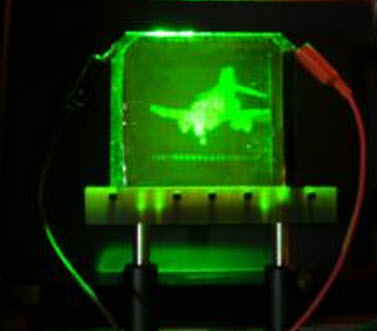
A team led by University of Arizona (UA) optical sciences professor Nasser Peyghambarian has developed a new type of “holographic telepresence” that allows remote projection of a three-dimensional, moving image without the need for special eyewear such as 3D glasses or other auxiliary devices.

The technology is likely to take applications ranging from telemedicine, advertising, updatable 3D maps and entertainment to a new level.

The journal Nature chose the technology to feature on the cover of its Nov. 4 issue.

“Holographic telepresence means we can record a three-dimensional image in one location and show it in another location, in real-time, anywhere in the world,” said Peyghambarian, who led the research effort.
“Holographic stereography has been capable of providing excellent resolution and depth reproduction on large-scale 3D static images,” the authors wrote, “but has been missing dynamic updating capability until now.”
“At the heart of the system is a screen made from a novel photorefractive material, capable of refreshing holograms every two seconds, making it the first to achieve a speed that can be described as quasi-real-time,” said Pierre-Alexandre Blanche, an assistant research professor in the UA College of Optical Sciences and lead author of the Nature paper.

The prototype device uses a 10-inch screen, but Peyghambarian’s group is already successfully testing a much larger version with a 17-inch screen. The image is recorded using an array of regular cameras, each of which views the object from a different perspective. The more cameras that are used, the more refined the final holographic presentation will appear.

That information is then encoded onto a fast-pulsed laser beam, which interferes with another beam that serves as a reference. The resulting interference pattern is written into the photorefractive polymer, creating and storing the image. Each laser pulse records an individual “hogel” in the polymer. A hogel (holographic pixel) is the three-dimensional version of a pixel, the basic units that make up the picture.

The hologram fades away by natural dark decay after a couple of minutes or seconds depending on experimental parameters. Or it can be erased by recording a new 3D image, creating a new diffraction structure and deleting the old pattern.

Peyghambarian explained: “Let’s say I want to give a presentation in New York. All I need is an array of cameras here in my Tucson office and a fast Internet connection. At the other end, in New York, there would be the 3D display using our laser system. Everything is fully automated and controlled by computer. As the image signals are transmitted, the lasers inscribe them into the screen and render them into a three-dimensional projection of me speaking.”

The overall recording setup is insensitive to vibration because of the short pulse duration and therefore suited for industrial environment applications without any special need for vibration, noise or temperature control.

One of the system’s major hallmarks never achieved before is what Peyghambarian’s group calls full parallax: “As you move your head left and right or up and down, you see different perspectives. This makes for a very life-like image. Humans are used to seeing things in 3D.”

The work is a result of a collaboration between the UA and Nitto Denko Technical, or NDT, a company in Oceanside, Calif. NDT provided the polymer sample and media preparation. “We have made major advances in photorefractive polymer film fabrication that allow for the very interesting 3D images obtained in our Nature article,” said Michiharu Yamamoto, vice president at NDT and co-author of the paper.

Potential applications of holographic telepresence include advertising, updatable 3D maps and entertainment. Telemedicine is another potential application: “Surgeons at different locations around the world can observe in 3D, in real time, and participate in the surgical procedure,” the authors wrote.

The system is a major advance over computer-generated holograms, which place high demands on computing power and take too long to be generated to be practical for any real-time applications.

Currently, the telepresence system can present in one color only, but Peyghambarian and his team have already demonstrated multi-color 3D display devices capable of writing images at a faster refresh rate, approaching the smooth transitions of images on a TV screen. These devices could be incorporated into a telepresence setup in the near future.

Source: http://www.kurzweilai.net


August 26, 2010

Diamonds Are a Supercomputer’s Best Friend


Diamond sheets filled with holes could be the key to the next generation of supercomputers.

Scientists in California have used commercially available technology to pattern large sheets of diamonds with tiny, nitrogen-filled holes. The nitrogen-vacancy diamonds, as the sheets are called by scientists, could store millions of times more information than current silicon-based systems and process that information dozens of times faster.

Exactly how diamond-based computing would be used has yet to be determined, but applications could range from designing more efficient silicon-based computers to drug development and cryptography.

Nitrogen has been in diamonds for as long as their have been diamonds; it’s why some diamonds have a yellow hue. For years scientists have used these natural, nitrogen-infused diamonds to study various aspects of quantum mechanics.

“We’ve used well-known techniques to create atomic-size defects in otherwise perfect diamonds,” said David Awschalom, a scientist at the University of California, Santa Barbara and co-author of a new article in the journal ACS Nano Letters.

A supercomputer based on quantum mechanics requires more precision than nature can provide, so scientists have searched for a way to artificially implant arrays of precisely patterned nitrogen holes inside sheets of diamond.

Scientists from the University of California, Santa Barbara, along with colleagues from the Lawrence Berkeley National Laboratory, created such an array by using an ion beam to first knock out two carbon atoms, and then replace them with one nitrogen atom. In one second, the scientists could inject about 4,000 glowing nitrogen atoms. In about one minute, the scientists had patterned several inches of flat diamond.

The scientists didn’t use any overly complicated techniques to accomplish this. “You can buy it online, send it to another company for the patterning, and then explore it yourself,” said Awschalom, whose students did exactly that to demonstrate the ease of the technology.

The key to a diamond-based quantum mechanical computer is an extra electron in the hole. In a traditional computer, information is encoded as either a “0″ or a “1.” In a diamond-based quantum computer, information could be stored in the spin of that electron. This means information could be stored as not only a “0″ or “1,” but also the direction the electron is spinning.

An exact number is hard to come by, but scientists say this would dramatically increase the computing power compared with existing silicon computers.

Diamonds likely wouldn’t replace the silicon used in today’s consumer computers, said Ray Beausoleil, a fellow in Information and Quantum Systems at HP. “A quantum computer won’t help you add two numbers faster,” said Beausoleil.

However, that doesn’t mean consumers won’t benefit from a diamond-based quantum computer. What it will do is help model certain extremely complex problems, says Beausoleil and David DiVincenzo, a scientist at IBM who is also familiar with the Nano Letters article.

“This points to the fruitful end of a very long search of all the things that you could put in diamond to make it electronically active,” said DiVincenzo.

Diamonds aren’t a sure bet for a quantum computer, said DiVincenzo, but they’re certainly in the running because of this research.

Source <http://tech-stories.findtechnews.net>

August 15, 2010

A Car for the Modern Fred Flintstone


Fred Flintstone could only dream of such a car. The HumanCar Imagine PS, a four-seater vehicle that uses hand cranks, can take on hills at 30 miles per hour, exceed 60 mph on flat terrain and is expected to hit the market next year.

The vehicle has electric plug-in capabilities, so it can still run if only one person is operating the hand-crank in a rowing-like motion (see the video showing the action, below). When four people are all rowing, it can run on human power alone. This thing is truly a "human-electric" hybrid. The chassis is adaptable, and can work with different kinds of batteries and technology in the future without requiring an entirely new vehicle.

Getting it going looks a little bit like those wind-up toys: a few front-to-back pulls on the two-hand crank and it's ready to take off. Despite the physical requirement, the company says online that a senior citizen in decent shape could handle it and paraplegics have made suggestions on adaptability. The sleek vehicle could use a larger windshield, although there is apparently an all-weather shell available. Airbags are on the list to be included in future models. In the meantime, I'd probably wear a helmet while driving it.

Others have been hard at work on human powered cars, too. The American Society ASME runs an annual international Human Powered Vehicle Challenge, where students build aerodynamic vehicles. Next month teams will compete in Venezuela. Based on speed-endurance events that took place this year, the vehicles' top speeds are closing in on 20 miles per hour.

Higher speeds make the Imagine PS impressive. I can hardly get any miles per hour going uphill on a bike. Zooming uphill using my own energy looks so much more enjoyable. The car will cost $15,500 when it goes on sale next year, according to the HumanCar site. Potential owners can put down a refundable $50 placeholder for when the vehicles become available. So far, the company says it has 100 pre-orders and that production will begin when they reach 800.

Source <news.discovery.com>

July 8, 2010

Solar plane completes maiden flight

June 30, 2010

China hosts first Robot Olympics


The World’s first International Humanoid Robots Olympic Games kicked off on June 21, in China’s Harbin’s Institute of Technology.

Two years after hosting a memorable edition of the human Olympic Games, China becomes the first country to host an Olympics dedicated to humanoid robots. Nineteen teams, from China, United States, Japan, South Korea or Germany have brought their best robots to compete in this historic three-day event.

To enter the competition, robots had to be less than 60 cm long, and have a human shape, with a head, two arms and two legs. Just like in the real Olympic Games, the sporty robots had to compete in multiple challenges, 24 to be exact, ranging from boxing, to weight-lifting, dancing, or sprint. But there are also some unusual domestic events, like cleaning or medical care.

The sprinting contest took place on the first day, with the winner running a distance of five meters in 20 seconds flat. Not bad for a small robot, I think. Check out the video at the bottom, to see these little guys sweating silicone at the Robot Olympic Games.

Source <www.odditycentral.com>

June 29, 2010

How to hold your new iPhone 4


Apple has released official advice for iPhone 4 owners to overcome the problem of the device losing signal when held by the lower left corner.

Steve Jobs responded to a query about the problem from one owner by saying: "Just avoid holding it in that way."

Except that it seems that Apple themselves have got it wrong and have gotten to grips with how to hold the new phone.

Well it seems that while us mere mortals will have to settle for buying a rubber outer casing in order to ensure that we can continue to have a reasonable signal, one Intergalactic user has figured it out....I wonder what price plan he has got?


Source <www.geeksaresexy.com>

Make your own micro SIM

We've finally found ourselves a solid, confirmed shot of a micro SIM in the wild, thanks to an FCC filing from Lok8u -- the company that just inked a deal with T-Mobile -- that shows the innards of its GPS watch torn asunder. Over on the right there is one of the micro SIMs in question, and as you can clearly make out, the contact pad is identical to the one you'd find on a traditional SIM.

In other words, if you were really hard up to get that iPad or iPhone up and running on a network that isn't providing micros, you could probably shoehorn a traditional SIM in there with a little elbow grease and handiwork, which happily matches up with information we've been hearing from several contacts of ours. Who knew Lok8u would be so important in this investigative process?

Update: The ETSI has also confirmed to CNET UK that micro SIMs are electrically identical to their older counterparts, so that's a promising sign, and Boy Genius tells us that he used to shave down SIMs to micro SIM size back in the day for dual SIM adapters -- in other words, you're probably not going to damage the chip by trimming (and even if you do, it's a simple replacement from your carrier).

Source <www.engadget.com>

April 9, 2010

How many orange slices to charge an Iphone ?

It takes almost 2300+ slices of oranges to be able to charge an Iphone !

January 21, 2010

Trilobis 65 Floating Home


Trilobis 65 is a semi-submerged
dwelling environment. Reaching 20 metres in length designed by Giancarlo Zema for habitation by six people at sea. It is ideal for living in bays, atolls and maritime parks. The main aim of the project is to allow anyone to live in a unique environment through a self sufficient, non-polluting dwelling cell in unison with their ocean surroundings.


Trilobis 65 has been designed on four separate levels connected by a spiraling staircase.
The top level is 3.5 metres above
sea level. The next level is at 1.4 metres above sea level and hosts the daylight zone with all services and allowing outdoor access. The third level is situated at 0.8 metre below sea level, semi-submerged, and is devoted to the night-time zone. At 3.0 metres below sea level, totally submerged, there is the underwater observation bulb, an intimate and mediative place.


The shape of Trilobis 65 allows the annular aggregation of more
modular units, creating island colonies.

This special project refers to the Trilobiti, little creatures that lived in the sea 500 milion years ago.
Contact Underwater Vehicles Inc. for further details regarding custom floating homes and Neptus 60 cliff-side dwellings with underwater viewing compartments. All homes are engineered to meet strict ABS and Lloyds certification requirements.

Maximum length - 20 mt
Maximum width - 13 mt
Observation bulb - 3 mt o.s.l. Max Speed - 7 knots
Accommodation - 6 beds
Power source options - Ballard fuel cells, solar, wind, diesel


New - from Giancarlo Zema Lake Washington Commercial and Recreational Marine Park


More here


January 4, 2010

World's tallest building in Dubai

By Malcolm Borthwick


Editor, Middle East Business Report, BBC World, Dubai
 

In recent years Dubai has grabbed the headlines with audacious offshore islands, rotating buildings and a seven star hotel. On Monday it opens the world's tallest building, Burj Dubai.


It's about twice the height of the Empire State Building, you can see its spire from 95km away and the exterior is covered in about 26,000 glass panels, which glisten in the midday desert sun.

The design of the building posed unprecedented technical and logistical challenges, not just because of its height, but also because Dubai is susceptible to high winds and is close to a geological fault line.

"You have the solutions for it but you always wonder how it will really work," Mohamed Ali Alabbar, chairman of Emaar, the developer behind Burj Dubai told the BBC.
 
"We have been hit with lightning twice, there was a big earthquake last year that came across from Iran, and we have had all types of wind which has hit us when we were building. The results have been good and I salute the designers and professionals who helped build it."
 
Rest of the story here

December 28, 2009

World's First Solar Powered Stadium

Taiwan recently finished construction on a solar-powered stadium
that will generate 100% of its electricity from photovoltaic technology designes by
Toyo Ito, the 50,000 seat arean will officially open later this year to welcome the 2009 World Games which features many sports not included in the Olympics such as parachuting, tenpin, bowling and rugby sevens.


December 18, 2009

Scientists Succeed With Teleportation Experiment


This story gets a little heady and, to be honest, we're not entirely sure we completely understand it ourselves. What we do know is that scientists have made a huge advancement in the field of teleportation, taking a step necessary to the development of quantum computers.

Scientists managed to teleport information from one atom to another from a distance of about one meter. While this isn't really getting us much closer to the 'Star Trek'-like ability to beam people around the universe, it does allow for instantaneous transmission of information without it passing through physical space.

Previously, similar accomplishments have been made with photons (the basic unit of light) and between nearby atoms with the assistance of a third, but these have not proven useful for the long-term storage and long-distance transmission of information.

This breakthrough was accomplished using a phenomena known as quantum entanglement. Atomic and sub-atomic particles can be entangled, meaning their states (such as spin or polarization) are linked, regardless of distance and obstacles. The state is unknowable until a measurement of either particle is made (see Schrödinger's cat), but once the state of one particle is measured the state of the other is instantly determined.

Once the atoms are entwined, the state of atom A is measured, destroying the data, which then reappears when the scientists go to retrieve it from atom B. The information isn't transmitted from A to B, it "teleports," instantaneously disappearing and reappearing with out any interaction between the atoms.

Not confused enough? Hit the read link for more head-scratching detail on the experiment. [From: FOXNews.com]

Source : http://www.switched.com/2009/01/26/scientists-succeed-with-teleportation-experiment/

December 14, 2009

Machines of Gods 1/5

November 27, 2009

Meta materials can create "living" architecture wonders

Twitter Delicious Facebook Digg Stumbleupon Favorites More

 
Powered by Blogger